Planning Machine
It is used
to perform almost the same operations as are done on a shaper but jobs
of comparatively larger size are machined on the planner.
It is
commonly used for machining large flat surfaces or machining similar
jobs more in number keeping the line. The surfaces to be machined may be
horizontal, vertical or inclined. Several tools can be fitted on this
machine to work separately or at a time to give faster output.
CONSTRUCTION
Bed:
It is a very
large and heavy cast iron structure which is provided with cross ribs
for additional strength and stiffness. In case of large planers the bed
is sometimes made in two parts which are properly machined and then
bolted together to form a single length of bed.
Leveling pads
or jacks are provided under the bottom of the bed to level it during
its installation. The bed itself accommodates the table driving
mechanisms. V-ways and sometimes flat ways are provided on the top of
bed to guide and support the reciprocating table of the planer. These
bed ways are straight and parallel accurately machined and scrapped. The
bed ways should be constantly lubricated.
Table:
The table or
platen is also made of cast iron with an accurately machined top. It
carries a box type construction provided with strengthening ribs under
it in order to make it strong enough to support the heavy work over it.
At its top it has longitudinal T-slots and holes to accommodate the
clamping bolt and other devices.
Under the
table chip pockets are cast integral with it for collecting and removing
the chips. On its side the table carries adjustable stops to reverse
its motion at the end of each stroke. A common safety device i.e. large
cutting tool is bolted under the table on its both sides and stops
blocks are fixed on the bed on each side.
In case of
running away of the table the tool will take a deep cut into the stop
block and thus absorb the whole kinetic energy of the table, bringing it
to a halt without damage to machine or workman.
Housing and columns:
These are
vertical members situated on both sides in case of double housing planer
and on one side only in case of an open side planer. Inside them they
carry the different mechanisms for transmission of power to the upper
parts of the machine. The vertical guide ways along which the cross rail
slides up and down are machined at the front of columns, where side
tool heads are used, they also slide vertically along the same ways.
Cross rail:
It is a
horizontal member of heavy structure which connects the two vertical
housings of the machine. It provides additional rigidity to the machine.
By means of elevating screws it can be moved up and down along the
guide ways.
Clamps are
provided to lock the cross rail in any desired position along the
columns. In order that the cross rail is moved up or down uniformly on
both ends, both the elevating screws are rotated simultaneously by
horizontal shaft, mounted on the top of the machine.
Accurately
finished ways are provided at the front of the cross rails for the two
vertical tool heads. Inside the rail the feed rods for vertical power
feed and cross feed for the tools are provided.
Tool heads:
The planner
tool heads resemble with shape tool heads in construction as well as in
operation. Four tool heads can be fitted in a planer and any or all of
them can be used at a time. Two tool heads can be fitted in a vertical
position on the cross rails and the other two can be fitted in
horizontal position on the vertical columns.
The tool
head on the cross rail can travel horizontally along the cross rail.
They can also be raised or lowered moving the cross rail up and down.
The side tools can move up and down along the vertical column ways. The
side tools can be fed horizontally into the job or at a desired
inclination.
Both hand
and power feeds can be employed for all the tool heads. The tool head
can swivel on either side from its normal position and the apron can
also be set at an inclination whenever needed in the same way as in
shaper head. The clapper block is also hinged in similar way as in
shaper so as to avoid scratching during idle stroke.
Controls:
Various
controls for governing the action of different parts of planer are
systematically provided in the easy reach of the operator. The controls
may be provided on a suspended pedant easily approachable by the
operator. A suspended pedant usually has the controls like start, stop,
automatic cut, automatic return etc. The controls are devices for quick
adjustments of vertical or horizontal tool feeds, control for rapid
transverse of the tool heads individually or together. These controls
sometimes increases the work efficiency.
Carpentry tools
1. MEASURING TOOLS
a. Four fold box wood rule:
It is generally 2 feet long and is folded from three places. It is marked with inch and millimetre scale. The inches are further divided into 8 and 16 parts, whereas the centimetre are sub-divided into millimetres. It is used for measuring and marking.
b. Steel rule:
It is made of stainless steel and is marked with scales. In this scale also there is graduation in both inches and centimetre. Inches and centimetre are further divided into smaller divisions. In this scale the conversion table between different units is also mentioned.
c. Contraction scale:
It is also a rule type scale used for marking patterns. Casting allowances are added to this scale.
d. Inch tape:
It is made up of flexible thin steel strip. It is folded around a center pin attached with a small handle. It is graduated.
2. MARKING TOOLS
a. Pencil:
Lead pencil is generally used for marking purposes.
b. Scriber:
It has sharp conical edge used to mark on even hard surfaces. The front edge is hardened so as to resist wear and tear. It is made up of carbon steel. It is used for measuring and marking the points and lines on the wooden stock before processing.
c. Marking gauge:
It is used to draw parallel lines. The movable portion of the gauge is adjusted to suitable position and is tightened on the stem. The piece which slides is called as stock and a scribing pin is fixed on the stem. One face of the stock remains in contact with the job while marking, by the help of thumb screw, we can tighten the stock anywhere on the stem.
d. Mortise gauge:
It is used to draw two parallel lines. Its working is similar to marking gauge except it has two sharp edges. One fixed and second adjustable or fixed.
e. Try square:
It is used to draw lines at right angle, parallel, or to check the trueness of planed surface, it is made up of a steel blade with a heavy base.
f. Bevel:
It consists of a wooden handle fitted with adjustable blade. The blade can be rotated by 1800 with respect to handle. It is used for marking various angles.
g. Compass/ dividers:
These are used for dividing equal number of parts and for drawing arcs and circles. It consists of two legs with a spring on the top of legs. A screw is also attached at the centre of legs for adjustment.
3. CUTTING TOOLS
a. Saw
A saw is multi-tooth tool made up of thin sheet attached with a wooden handle. Its teeth are ground and sharpened to achieve smooth cutting. Different types are:
1. Rip saw:It is hand saw from 30 cm to 75 cm long containing one to one and half teeth per cm. It should not be called a hand saw but a rip saw only. Cutting of the wood is done along the grains, nearly the entire length of the saw blade is used for cutting. Cutting takes place in the forward stroke and backward stroke is ideal.
2. Tenon saw:It derives its name from the tenon form of joint. It is a thin saw ranging from 20-40cm. long, and is supported by back of wrought iron or brass; hence it is also called back saw. It contains about 4 teeth to a cm. It is used primarily for short cuts such as for tenon’s. so, the blade is provided with a reinforcing strip or back at the top so the blade is prevented from bending during operations.
3. Coping saw:It is used for cutting quick or sharp curves either internal or external. For cutting the internal surfaces first drilling is done and then the saw blade is inserted in the hole for cutting. It consists of approximately 10 teeth per cm.
4. Compass saw:It is a short narrow saw, tapering towards the point, used for cutting sweeps and large interior curves by hand, sometimes termed as a table saw.
5. Keyhole saw or Pad saw:It is used for cutting thick internal curves where it is impossible to use other saws.
6. Cross-cut saw:It is a saw provided with two handles, one at each end. Used for cutting heavy timber across the grains.
7. Bow saw:It consists of a wooden frame, a bar, a string, lever and two handles. It is used to produce curved surfaces with quick turns. The blade is tightened with the help of string and lever.
***SETTING OF SAW TEETH: The teeth of saw are bend in opposite direction alternatively. It is known as saw teeth setting. It is made to form a clearance between two cutting edges so that the saw may work without any restriction.
b. Chisels
1. Firmer chisel:It is general purpose chisel used to finish inside grooves. It has various sizes of cutting edge depending upon the work to be done. Width varies from 5-35 mm. The cross section of the blade is rectangular in shape the wider portion of the rectangle shows the width and the smaller side the thickness.
2. Mortise chisel:It is used to make mortises. This chisel is used for heavy cuts. The blade thickness varies from 5-12 mm. because of wider thickness this blade is stronger in comparison to other chisel of same size, therefore, it is capable of taking the heavy blows.
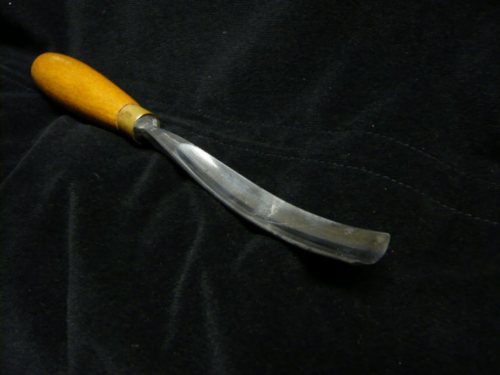
3. Gauge chisel:It is used to finish curved holes. Gauge chisel are of two types i.e. inside and outside.
4. PLANNING TOOLS
These tools are used for smoothening purposes, preparing proper sizes and for forming curved wooden strips. Different types of planes are:
a. Wooden jack plane:
It s length is 20”-30” and used for general purpose. It consists of a wooden body called as stock at an angle 450 with respect to sole and material of the blade is high carbon steel. The projection of the blade from the sole is controlled by tapered wooden wedge.
b. Iron jack plane:
This plane is used for better finish. It is made of cast iron with wooden handle at the back and a wooden knob at the front, so that it can be held by both the hands during operation. This plane have a rigid and stronger body in comparison to wooden jack plane, but it is costlier.
c. Trying plane:
The length of this plane is 20”-30” and looks like a jack plane. It is used after surface is already planed by iron jack plane for making it true.
d. Rebate plane:
This plane is used to prepare the edge of a board, the cutting edge of the blade can be adjusted for cutting rebates of different width and depth and it is used mostly for making household furniture’s.
e. Plough plane:
This plane is used for making groove at the same time there is also another plane called hollow plane that is used for producing the curved grooves.
f. Spoke shave:
The blade of the spoke shave can be adjusted i.e. blade can be raised or lowered at the same time it can adjusted laterally also by the help of nuts. In case of smoothing a concave inside surfaces a spoke shave having round bottom is used.
g. Rasp:
It is also known as rasp file. It is a finishing tool used to make the wood surface smooth, remove sharp edge, finishing fillets and other interior surfaces. Sharp cutting teeth are provided on its surface for this purpose. This file is used in wood work only.
5. DRILLING AD BORING TOOLS
a. Hand drill:
It consists of a spindle, drill chuck, crank, handle and two bevel gears. Bevel gears are fitted on the body. Drill is held in chuck and rotation to spindle is given through gears with the help of crank. The handle is pressed into the wooden piece while rotating the drill. Thus hole is formed.
b. Ratchet brace:
It consists of a crank, a head, a ratchet and a chuck for holding the drill. Any type of drill or drill bit can be held in the chuck. The head is pressed with one hand and the crank is rotated by the second hand.
c. Gimlet drill:
This drill is very simple type of drilling tool. It consists of two parts. One is gimlet and second is drill. Gimlet is made from a long twisted bar. It has a screw type starting edge. While drilling it is rotated and pressed on the wooden work piece with the help of the handle.
6. HOLDING TOOLS
a. Work bench:
It is table which is made of sal or sheasour wood. Size of table is 6’ * 3’. Two to four carpenter’s vice are fixed at the four corners of the table. This table acts as a base for all the carpentry or wood working operations.
b. Bench hook:
It is a simple type of holding tool used for supporting the wood while working on it. It is used on work bench. Sawing and planning are mostly done on it.
c. Clamping vice:
It is used for sawing, joining or cutting more than one strip of wood at the same time. It’s one end is clamped to the table while the other is kept movable. Vice is made up cast steel and jaws are lined with hard wood.
d. C-clamp:
It is simple type of clamping device. It is generally used to paste one wood on the other or for alignment purposes.
7. STRIKING TOOLS
These are used to force the nails or chisels into the wood. Main striking tools are:
a. Cross pean hammer:
It has a cast steel body and a wooden handle. Body has two parts face and pean. In this hammer the pean is in the form of narrow round edge ridge placed at right angle to the axis of the handle.
b. Claw hammer:
It is used for striking as well as for pulling the nail from the wood. The material of the wood is case steel. One end is made striking and the second is claw face. Its weight varies from 0.25-0.75 kg.
c. Mallet:
It is used to strike the chisels which have wooden handles. It is made up of a hard wood and is round or rectangular in shape.
8. SHARPENING TOOLS
Water stone:
It is a rectangular piece of stone generally kept in a wooden base. It is used to re-sharpen the chisels, bits, plane blades and other tools. While sharpening water is sprinkled on the stone.
9. AUXILARY MATERIALS USED IN CARPENTRY
a. Nails:
Nails are used for fastening different wooden parts. These are made up of low carbon steel, brass or copper. These are available in the many shapes and sizes in the market. The size is taken as the overall length of the nail and wire diameters.
b. Screws:
Screws are generally used for fixing metallic fittings like handles, hinges etc. and joining different wooden parts. The screws give better strength to the joints then nails. These are also available in different shapes. A hole is drilled before putting the screw. Screw are made up of bright drawn wire.
c. Bolts and nuts:
These are used for making heavy joints. These are specified by the length, diameter and pitch of the thread on it. Bolt is inserted in a pre-drilled hole and nut is tightened by placing a washer in it.
d. Glues:
The pastes used for joining various wooden parts are known as glues. A permanent joint is formed with glue. Surface to surface and face to face joints can be easily made with glues.Glues are used cold as well as hot. The commonly used glues and animal glue, resin glue, vegetable glue, milk glue, blood-albumen glue and contact cement.
e. Paint:
It is a semi liquid past prepared by mixing a base, a vehicles and a pigment. Driers and fillers are also added in it to obtain good quality.
Functions of paint:1. To protect the surface from moisture and corrosion.2. To improve the appearance.
Properties of a good paint:1. It should be dry quickly.2. It should give a pleasing appearance after drying.3. It should not show cracks after drying.4. In wet condition, it should have enough flowing power.5. It should not be affected by moisture.6. It should not change the color due to heat or water spread on it.7. It should have long life.8. It should be easily available at reasonable cost.